
Stethoscope: The Tool Everyone Sees and Almost No One Questions
The stethoscope is, by any measure, the most encountered medical instrument in the world. Most of us met it within moments of being born. We recognize it instantly in films, in advertisements, around the necks of doctors on television, and in the profile photographs of medical professionals on social media.
Yet remarkably few people, patients or clinicians, have ever been taught to ask a simple question: How accurate is what it tells us?
It does not ask whether the stethoscope should exist or whether auscultation has value. It asks what it means to use a tool for two hundred years without ever rigorously measuring whether its interpretations hold up.
A Simple Instrument
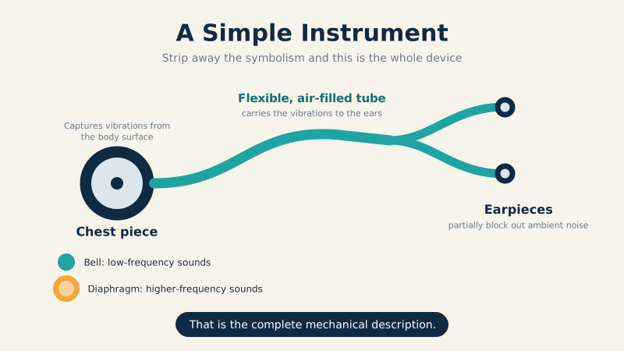
Strip away the symbolism and the stethoscope is a straightforward device. It captures vibrations from the body surface and carries them through a flexible, air-filled tube to the clinician’s ears.
The chest piece has two sides: the bell for low-frequency sounds and the diaphragm for higher ones. The tube connects them to earpieces that partially block out ambient noise. That is the complete mechanical description.
The Physics of a Whisper
The sounds it captures, such as heart sounds, breath sounds, and bowel sounds, are low-frequency and low-amplitude. Normal heart sounds register at roughly 20 to 40 decibels, comparable to a whisper in a quiet room. The S3 and S4 sounds, which carry clinically significant information about cardiac function, fall below 20.
The human ear, already limited in range compared with that of a dog or an elephant, is asked to detect sounds quieter than a whisper, through a curved rubber tube, in an environment that is rarely silent.
How a Tool Becomes a Symbol
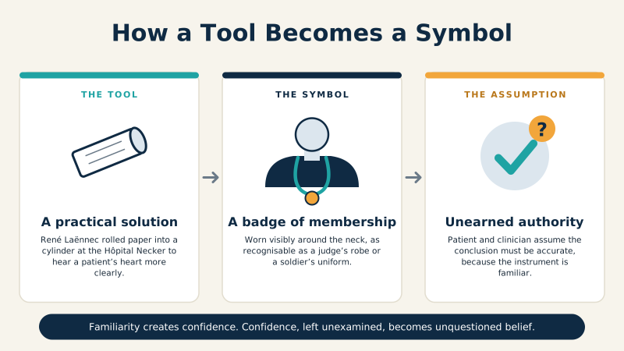
When René Laënnec first rolled paper into a cylinder at the Hôpital Necker, he was solving a practical problem: he needed to hear a patient’s heart more clearly. What emerged was useful and understood to be a tool, one among many ways of gathering clinical information.
Over the next two centuries, in an era before modern imaging, auscultation became one of the primary methods of clinical assessment. Films reinforced the image. Medical institutions reinforced it. The instrument became a badge of professional membership, worn visibly around the neck and as recognisable as a judge’s robe or a soldier’s uniform.
That is not, in itself, a problem. Every profession develops its symbols. The difficulty begins when the symbol confers unearned authority on the practice it represents.
A patient sees a stethoscope placed on their chest and assumes that whatever conclusion follows must be accurate, because the instrument is familiar. A clinician reaches for the same instrument out of habit, without conscious awareness of its limitations. Somewhere in that exchange, a diagnostic shortcut has been taken.
Familiarity creates confidence. Confidence, left unexamined, becomes unquestioned belief. Unquestioned belief is perhaps the greatest obstacle to clinical accuracy.
The Burden of the Instrument
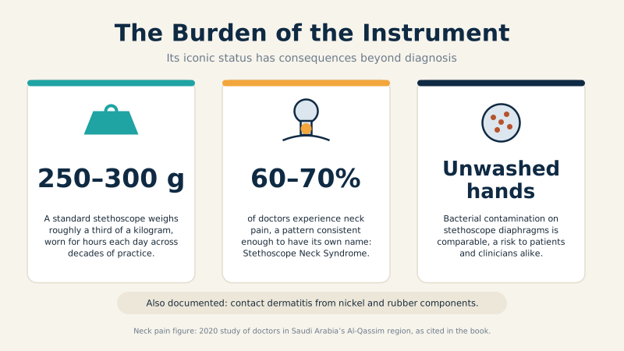
The stethoscope’s iconic status has consequences beyond diagnosis. A standard stethoscope weighs 250 to 300 grams, roughly a third of a kilogram. Worn around the neck for hours each day across decades of practice, that modest weight accumulates. Research cited in the book, a 2020 study of work-related musculoskeletal disorders among doctors in Saudi Arabia’s Al-Qassim region, found neck pain prevalence of about 60 to 70 per cent. The pattern is consistent enough to carry its own name: Stethoscope Neck Syndrome.
Then there is hygiene. In most clinical environments, the chest piece pressed against one patient’s skin is pressed against the next patient’s without cleaning. Studies have found stethoscope diaphragms carry bacterial contamination at levels comparable to unwashed hands, a risk to patients and clinicians alike. Contact dermatitis from the nickel and rubber components is a documented hazard for regular users.
None of this arises from hostility toward the instrument. It arises from taking it seriously enough to study it, rather than simply use it.
Sound as a Diagnostic Medium
Using a stethoscope means using sound as a medium for diagnosis, and physics matters here. Sound is mechanical energy, a vibration moving through a medium. It travels fastest through solids, faster through liquids, and slowest through air. The stethoscope transmits sound through air, inside a flexible rubber tube. Unlike a rigid pipe, a flexible tube makes sound reflect repeatedly off its inner walls. Each reflection distorts and attenuates the signal. The length of the tube, its internal diameter, and the properties of its material all shape what finally reaches the clinician’s ear.
Two further variables rarely appear in clinical training:
- Patient position. When a patient lies flat, the tube runs relatively straight. When the patient sits up, it bends. The degree of bending changes the quality of sound transmission, and most clinicians are unaware it is happening.
- The interface. The chest piece must touch bare skin. Over clothing, friction between fabric and diaphragm produces sounds that are easily mistaken for internal ones. On patients with significant body hair, friction at the skin surface can create the same confusion.
These are not hypothetical problems. They are routine sources of interpretive error.
Interpretation Is Not Observation
This chapter introduces the distinction the entire course asks you to keep in mind:
Observation is what the stethoscope captures. Interpretation is what the clinician does with it.
Over two centuries, auscultation has assembled a catalogue of approximately fifty distinct sounds, each named and each linked to a diagnostic category. A murmur of a particular quality points to aortic stenosis. A crackle in the lungs points to pneumonia. A wheeze points to asthma or obstructive airway disease. Every time a clinician places a stethoscope on a patient, they apply this catalogue, consciously or not.
The course asks whether the link between observation and interpretation is as reliable as clinical training assumes. Two clinicians, listening to the same patient with the same instrument at the same time, do not always reach the same conclusion. What they hear is shaped by the environment, the condition of the equipment, the position of the patient and the clinician, and their level of training and experience.
And, critically, by what they expect to find.
Expectation is not a minor variable. In some circumstances it is the dominant one. A clinician who has been told a particular illness is circulating widely may hear the sounds of that illness in a patient whose body sounds are, in fact, entirely normal.
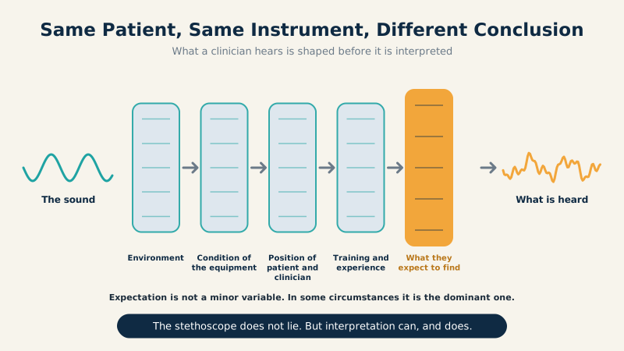
The stethoscope does not lie. But interpretation can, and does.
A Tool With Limits, Not a Tool Without Value
The argument is not that the stethoscope is useless. It is that the stethoscope is just a tool: a physical object operating within the laws of physics, capturing signals that are inherently weak and variable, transmitting them through an imperfect medium, to be interpreted by a human auditory system subject to fatigue, expectation, and bias.
Understanding these limits is not a threat to clinical competence. It is a precondition for it. A clinician who knows precisely what the stethoscope can and cannot tell them is more reliable than one who trusts it unconditionally. A patient who understands the instrument being used on them is better placed to take part in their own care.
The moment we stop questioning a tool is the moment it stops serving us well.