
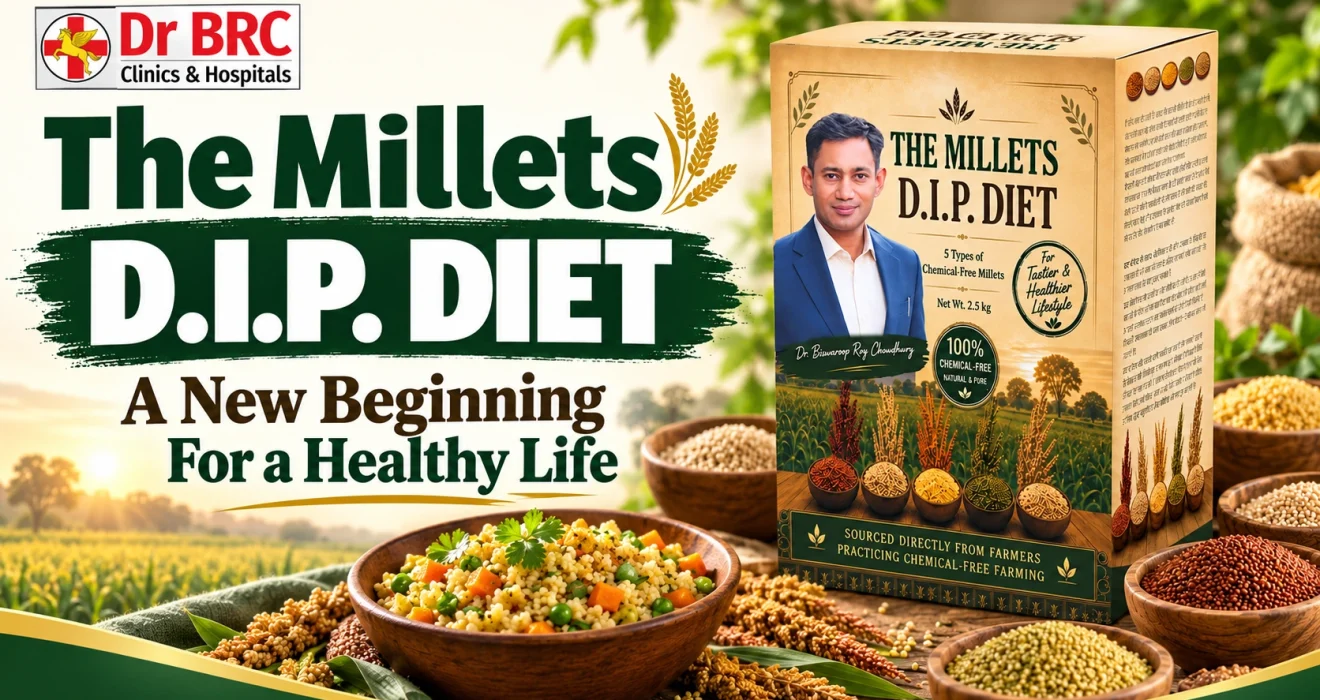
Millets work as medicine when they are used the right way. Millets grown without chemicals, as they were 5,000 years ago, can act as medicine in the body. Millets grown with chemicals look the same, but they lose their qualities.
A Grain With a 5,000-Year Record
About 5,000 years ago, in the Indus Valley and Harappan civilisation, millets were used in place of wheat. Many records confirm that this practice was common then and has since faded.
- Ayurveda, 2,500 years ago, describes millets in writing as vishahar, the destroyer of poison. If there is poison in your body, millets can overcome it.
- Chinese medicine, 5,000 years ago, records in writing that millets strengthen the kidneys, give a cooling effect, and act as a diuretic. A diuretic removes fluid that has accumulated in the body, as happens in liver and kidney patients.
- Ancient Chinese texts regarded the ruler with the most millets as the greatest king. These texts and their references are available, and anyone who checks them will find these points confirmed.
Why Chemical-Free Matters?
Today, if you look for millets, grains, or cereals in the market, you will not find chemical-free ones, and they will not act as medicine in your body. When millets are grown chemical-free, you can treat them as medicine. When chemicals are added and the crop is grown with them, the result still looks like millet, but its qualities are lost, and instead of being healthy, they turn harmful.
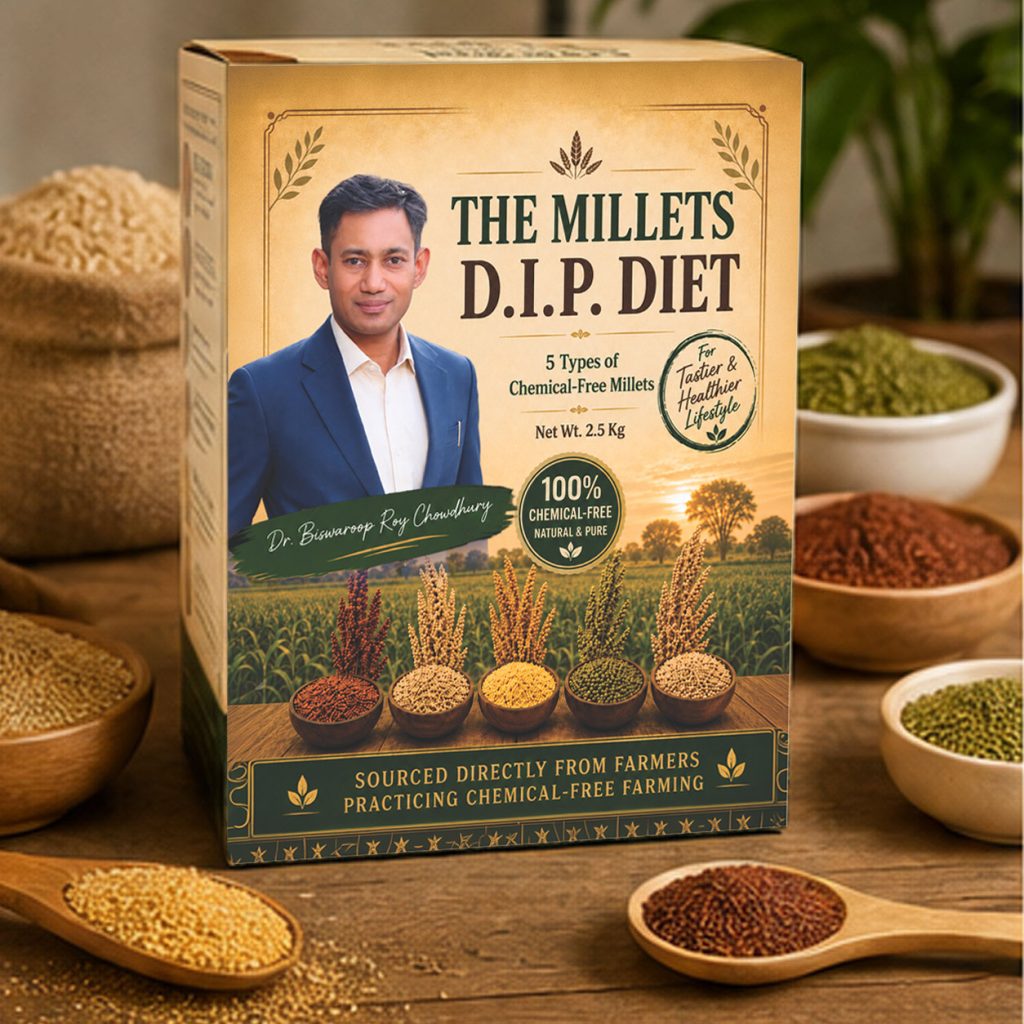
To solve this problem, Dr. BRC has launched the Millet D.I.P. Diet Box to let people have easy access to chemical-free millets.
The Millet D.I.P. Diet Box
The box holds five millets: Kodo, Foxtail, Little, Barnyard and Proso. Each is about 500 g. Two people can live on the box for a month following the DIP Diet, so it is a full month’s ration. It is available on our website, Amazon, Flipkart & Jiomart.
Five Millets, Five Strengths
- Kodo and Barnyard millet contain at least 500% more fibre than wheat, five times as much.
- Foxtail millet has the highest calcium of all the grains.
- Proso millet has the highest protein content. What matters is that the protein is digestible. Dairy and animal foods contain protein that is not absorbable. Proso millet contains an ingredient called prolamin, which lets the body absorb its protein properly.
- Little millet has iron at three times the level of wheat, 300% more.
How to Prepare Millets
Preparation of millets is as important as where they are grown.
- Soak them for at least six to eight hours before cooking.
- Cook them on a low flame.
- Do not use a pressure cooker. This way, millets will lose their nutritional value and become ordinary food that fills the stomach and can even cause disease. Cook them slowly in a pot.
Important Tip: The DIP Diet carries two restrictions: give up dairy products and give up non-vegetarian food. On top of that comes the switch from wheat and rice to the five millets.
Dr. BRC’s Practical Experiment
Our hospitals have not served wheat or rice for five years, since the first Dr. BRC hospital opened. Our patients eat chemical-free millets, which we source from our farmers. Treatment also does not depend on visiting a hospital. Anyone can order the box and recover at home.
Our 72-hour camps run every month. They are held in India, Vietnam, Malaysia, and the UAE. People come for a three-day camp, and when they leave, their medicines stop, including blood pressure tablets, insulin, and diabetes tablets. We give them millets and the DIP Diet and in 3 days their parameters all fall in healthy range enabling them to get rid of their medications that they have been taking for years and years with parameters going haywire.
Millets & Haemoglobin
A 2019 research paper shows that replacing wheat and rice with these five millets, rotated daily, can raise haemoglobin within a month.
Millets & Diabetes
Wheat is the biggest enemy of a diabetic. Among all the foods in the world, wheat has the greatest share in turning a person into a blood sugar patient. Diabetics should use the five millets in its place. Research papers on this are available worldwide, and we have seen it ourselves in our hospitals. With millet dosa, idli, chilla, and probiotic drinks, medicines and insulin can be stopped.
Millets & Heart Health
Research shows benefits for people with angina, heart trouble, palpitations, irregular heartbeat, and a very high or very low pulse rate. The benefit begins within a month.
Millets & Blood Pressure
A patient on blood pressure medicine who eats the Millets DIP Diet in rotation will see at least 50% of the medicine stopped within a week. Blood pressure stays normal.
Millets & Thyroid and Weight
- Weight: A person with unhealthy fats can lose up to 10% of their weight within a month with the help of the Millets DIP Die
- Thyroid: It takes one to three months for thyroid tablets to stop and thyroid levels to become normal. The patient must take millets for at least one month and see visible changes in their body.
Millets & Gut Microbiome
Countless kinds of bacteria live in our gut. Most are called good bacteria, and a few are bad. They stay in balance. The bacterial population renews with a new generation every four days. On the DIP Diet with properly prepared millets, positive change begins by the fourth or fifth day, as we have seen in our hospitals and patients. The gut microbiome changes, and digestive problems begin to resolve, including irritable bowel syndrome.
Millets & Neurodevelopmental Disorders
We currently have about 6,000 children who have or had autism and ADHD. When we put them on the DIP Diet, took away wheat and rice, and gave them millets, many of them showed remarkable improvements. Some recovered fully. Their autism and ADHD symptoms completely disappeared. Children who had delayed speech began speaking, attention span increased, and hyperactivity reduced.
We share these success stories on our social media every day, with videos of such children. Every three months, we also meet the children in person, and many of you may have met them. We have seen this benefit in brain disorders and neurodevelopmental disorders, and it is proven. My advice to parents of children with a neurodevelopmental disorder is to stop wheat and rice for the child and give the five millets in rotation. How to prepare them is a science in itself, and the QR code on the box explains the recipes and methods. The food is tasty, and the benefits are scientifically evidence-based.
Millets & Colon Health
People with piles, fissures, painful stools or blood in the stool, and even those told they have colon cancer, benefit. To see why, consider how the two grains behave.
- The carbohydrate in wheat is absorbed very quickly. It goes into the bloodstream at once, raises blood sugar suddenly, and upsets the body’s homeostasis.
- Millets are built so that they are absorbed slowly from the intestine. This controls blood sugar and the body’s homeostasis.
- Millets also have four to five times more fibre than wheat. Fibre is one way to heal the colon.
The trouble for the colon comes from gluten. Glu means glue, something sticky. Wheat contains a sticky substance. When you eat wheat, it goes into the intestine and colon and sticks there. Over time, infection grows at that spot, inflammation follows, and tumour growth can occur. The colon pipe slowly narrows, and diseases start from there. Millets contain no gluten, which is why they act as medicine. A 2015 research paper from Nature, one of the world’s most prestigious journals, supports these findings.
Millets & Cancer
All our hospitals put cancer patients on millets and the DIP Diet, like other patients. Their haemoglobin rises, their weakness goes away, and their pain reduces. Tumour growth slowly begins to recover too, though it takes three to six months. Reports from several journals support this, including a 2019 report in the journal Functional Foods. They contain a great deal of research, and I have placed some selected ones before you.
The Bigger Goal
My goal is not that you should come to our hospital and get well. My goal is that you recover where you sit… without medicine, while eating, drinking, laughing, and playing. A simple food that we ignored holds the answer to our health challenges.
The research I cite has already been established in modern medicine. Millets were also proven 5,000 years ago, and they are proven now.